| Home About Us Hypnosis NLP Private Sessions Workshops Testimonials Contact Us |
|
|
NEURO-LINGUISTIC PROGRAMMING
What is NLP?
Neuro-Linguistic Programming (NLP) involves the use of highly effective, targeted techniques rooted in hypnosis to assist people in achieving their goals.
Imagine this scenario: A child of 4 years old picks a rose from the rose bush. She excitedly presents it to her mother, anticipating her mother will be pleased with her as a result of this gift. Instead, fearful her daughter will get hurt with thorns if she continues this behavior, her mother responds by yanking the rose from her hand and yelling at her. The girl subsequently feels bad and ashamed, though not sure why.
- Neuro – Refers to how we take in information using our five senses of sight, sound, touch, taste and smell – our neurology. In the above example, in a fraction of a second, the little girl saw her mother's upset facial expression, heard her yell, and smelled the scent of the rose as she felt it being ripped from her hand. This experience led her to a rather unpleasant feeling state.
- Linguistic – Incorporates verbal and non-verbal communication. Here, the little girl heard her mother’s words and took in all of the non-verbal cues (facial expression, body language, tone of voice, etc.) In that brief moment, she interpreted the situation, made decisions about it, and put language to it: "I'm a bad girl. I shouldn't have upset mommy." At the same time, her brain encoded every tiny aspect of both the external event and the resulting feeling state.
- Programming – Implies how, in an experience with a high level of emotional intensity, the feeling state gets intertwined and connected to unique aspects of the experience. Later, an outside experience with similar unique characteristics will trigger the same feeling state.
Fast forward to the future... on the day after a lovely first date, the gentleman sends this woman a dozen roses with a card saying how much he'd enjoyed meeting her and asking her out again. The woman smiles and then smells the roses. Suddenly she feels bad and has no idea why. She does not see the man again.
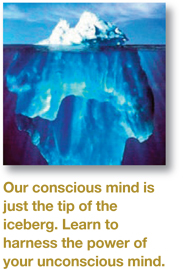
As you can see, the vast majority of this “programming” takes place outside of conscious awareness, and much of it is established when we are young children and do not have the adult perspective needed to more appropriately judge the situation. The decisions made in those moments ultimately form our core values and beliefs (whether we view the world as a friendly and helpful or unfriendly and potentially dangerous, and whether we see ourselves as good or bad, smart or stupid, lovable or unlovable, or something in the gray area between those extremes).
So how does this reprogramming take place?
1. Building and strengthening personal resources such as confidence, inner strength or creativity;
2. Connecting with the "part" of ourselves that is generating an unwanted behavior, discovering its positive intention, and implementing better alternatives that preserve the positive intention;
3. Dealing with painful past experiences by "disconnecting" the visual memory of the event and the feelings associated with it;
4. Moving from limiting beliefs to more empowering beliefs.
Unwanted behaviors such as overeating, excessive drinking, taking drugs, excessive spending, and gambling are, at a core level, an attempt to change an unpleasant feeling state. NLP techniques are specifically designed to teach people how to manage their feeling state without the need to engage in those unwanted behaviors. Once learned, individuals can practice them on their own for their own personal healing, without the need for further outside assistance.